Introduction
In recent years, customers have undergone a massive transformation in terms of expectations. Today’s customers expect instant answers, real-time support around the clock and a personalized experience from every business. Businesses that aren't able to fulfill these expectations, inevitably lose potential customers to other companies offering a quick and convenient experience.
That's exactly why the introduction of AI chatbots have made a revolution in terms of customer support, interaction and selling. What makes AI chatbots stand out from a typical rule-based chatbot? AI chatbots are designed with natural language processing (NLP) technologies and artificial intelligence (AI) that allow them to understand customer query in a human way, learn from each conversation and provide intelligently crafted answers, very similar to how humans answer. From startups and to major companies, businesses in all sectors are using AI Chatbots in their website, mobile apps, and messaging channels to enhance customer experience, automate simple processes and boosting sales.
In this thorough and detailed article, we will guide you through the AI Chatbots, their workings, applications and use cases.
What Are AI-Powered Chatbots?
The definition AI Chatbots or Virtual AI Assistants: An AI chatbot is basically a smart virtual assistant that employs different AI technologies like natural language processing (NLP), Machine Learning (ML) and Gen AI in order to understand the context of a user’s query and generate appropriate answers. Unlike traditional chatbots that were trained with pre-defined sets of questions and answers, AI chatbots learn with each conversation and thus continue getting better.
These intelligent assistants can:
- Answer customer questions instantly
- Recommend products or services
- Schedule appointments
- Generate leads
- Assist employees
- Process customer requests
- Handle multilingual conversations
- Escalate complex issues to human agents
The result is a smarter customer experience with minimal manual effort.
Why Businesses Need AI Chatbots
Customers don’t have business hours. As customers evolve and their needs shift in time zone and holiday consideration, you need to be ready to respond to requests at any hour of the day. The use of AI chatbots allows your business to exceed these expectations at lower costs.
Companies Are Incorporating AI chatbots in Business for several reasons: 24/7 Availability AI chatbots allow you to always be available, to assist the customer whether the hour is 11 AM or 11 PM.
Faster Response Time Rather than a waiting line that stretches down the block, customers can receive responses quickly with a AI Chatbot. Cost Effectiveness Instead of hiring more customer service personnel you are able to automate all of the low-level, repetitive questions, to free up your agents to focus on high-value, one on one, issues. Improved Lead Generation Using AI, you can proactively engage with visitors, collect their contact information, disqualify leads, or help guide the customer toward a purchase. Improved employee Productivity Instead of customers asking repetitive questions over and over, they are able to find the information they need and your employees are able to handle more challenging tasks, such as lead generation and customer relationship management.
A Personalized customer experience Chatbots that use machine learning and natural language processing, analyze behavior history, purchase information, and previous conversations to provide the ideal answer.
How AI-Powered Chatbots Work
Understanding the technology behind AI chatbots helps businesses make informed implementation decisions.
1. User Input
A customer asks a question through a website, mobile app, WhatsApp, Messenger, or another communication channel.
Example:
"I want to book a demo."
2. Natural Language Processing (NLP)
The chatbot analyzes the user's message to understand its intent and identify important keywords.
Instead of matching exact phrases, NLP understands context and conversational language.
3. AI Decision Engine
The chatbot determines the best response based on:
- Previous training
- Business knowledge base
- Customer information
- Historical conversations
4. Response Generation
The chatbot provides an accurate response, asks follow-up questions, or performs an action such as scheduling a meeting or generating a support ticket.
5. Continuous Learning
Machine Learning enables chatbots to improve over time by learning from customer interactions and feedback.
This creates increasingly accurate and natural conversations.
Key Features of Modern AI Chatbots
Businesses should look for these features when implementing AI chatbot solutions.
Natural Language Understanding
The chatbot understands conversational language instead of relying only on exact keywords.
Omnichannel Support
Customers can communicate across websites, mobile apps, Facebook Messenger, WhatsApp, Telegram, Slack, and other platforms.
CRM Integration
AI chatbots integrate with customer relationship management systems to access customer information and improve interactions.
If your business requires advanced chatbot integrations with existing software, you can explore our Custom Software Development Services here.
Analytics Dashboard
Businesses can monitor:
- Customer satisfaction
- Conversation history
- Resolution rate
- Popular queries
- Lead generation metrics
Multi-language Support
Global businesses can serve customers in multiple languages without expanding support teams.
Human Agent Handoff
When necessary, the chatbot transfers conversations to live support agents while maintaining conversation history.
Business Benefits of AI Chatbots
Improved Customer Experience
Customers receive immediate assistance without waiting for business hours.
Fast responses significantly improve customer satisfaction and retention.
Higher Conversion Rates
Chatbots engage website visitors before they leave.
They answer product questions, recommend solutions, and encourage purchases.
Lower Operational Costs
Customer support teams spend less time answering repetitive questions.
This reduces staffing costs while increasing efficiency.
Better Lead Qualification
Instead of collecting basic contact information, AI chatbots ask intelligent questions to determine customer requirements.
Sales teams receive higher-quality leads.
Data Collection
Every conversation provides valuable customer insights.
Businesses can analyze customer pain points, buying behavior, and frequently asked questions.
Scalable Customer Support
Unlike human agents, chatbots can handle thousands of conversations simultaneously without affecting response quality.
Common Business Use Cases
AI chatbots are transforming multiple industries.
E-commerce
- Product recommendations
- Order tracking
- Cart recovery
- Returns and refunds
- Customer support
Healthcare
- Appointment scheduling
- Patient inquiries
- Prescription reminders
- Health information
Banking and Finance
- Account assistance
- Transaction history
- Loan inquiries
- Fraud alerts
Education
- Student support
- Course recommendations
- Admission guidance
- Learning assistance
Real Estate
- Property recommendations
- Site visit scheduling
- Lead qualification
- Mortgage information
IT Companies
Technology businesses use AI chatbots to automate customer support, collect project requirements, and streamline client communication.
Businesses planning intelligent automation solutions can also benefit from our AI Development Services for building custom AI-powered business applications.
Steps to Build an AI-Powered Chatbot
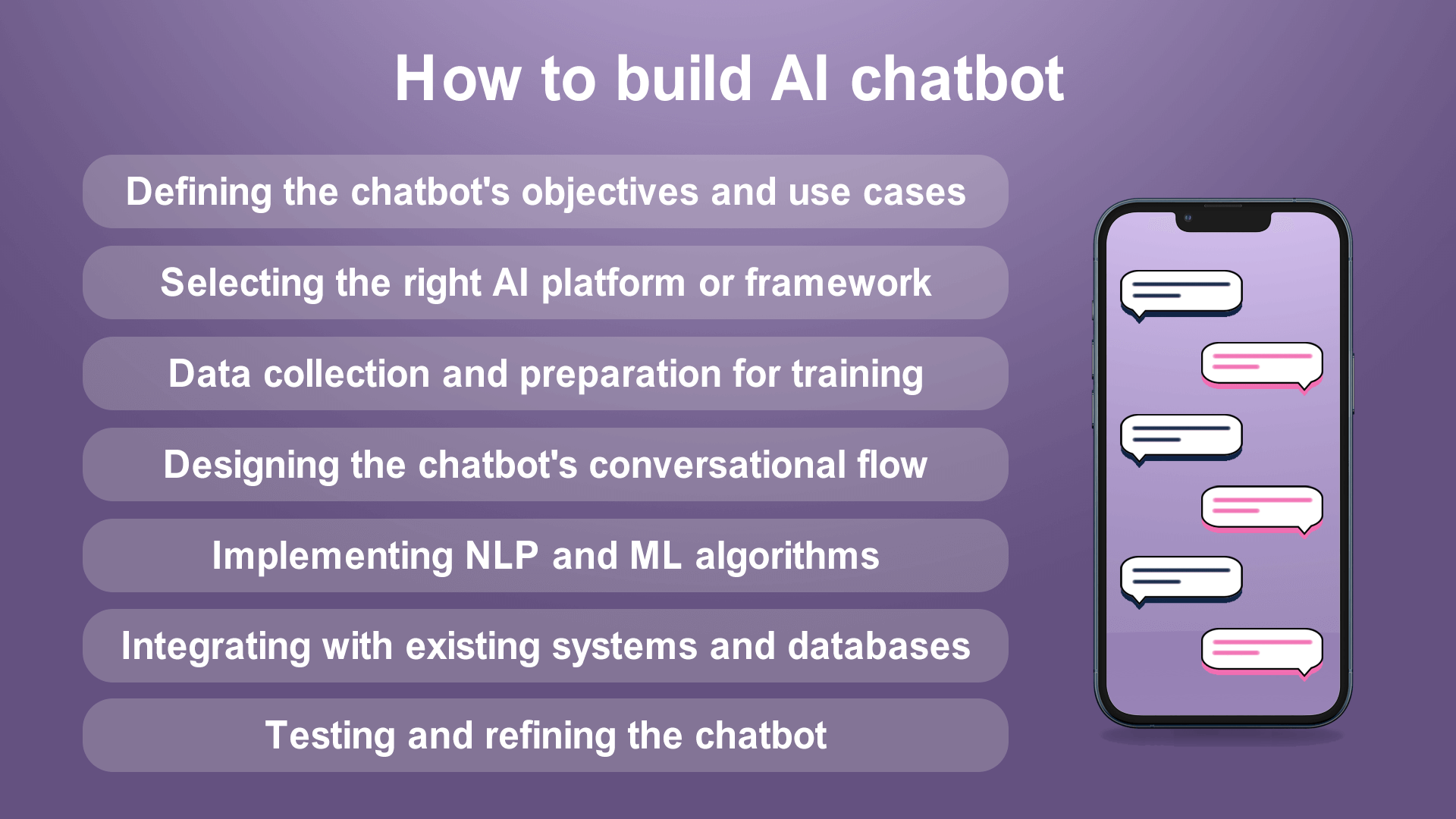
Step 1: Define Business Goals
Determine what you want the chatbot to achieve.
Examples include:
- Customer support
- Sales automation
- Lead generation
- Employee assistance
Step 2: Understand Your Audience
Analyze customer behavior and identify common questions.
The better your understanding, the more effective your chatbot becomes.
Step 3: Choose the Right AI Platform
Select technologies that align with your business requirements, scalability needs, and integration capabilities.
Step 4: Train the Chatbot
Provide:
- Frequently asked questions
- Product information
- Company policies
- Customer scenarios
The chatbot becomes more accurate with quality training data.
Step 5: Integrate with Business Systems
Connect the chatbot with:
- CRM
- ERP
- Inventory systems
- Payment gateways
- Email marketing tools
This enables automated workflows.
Step 6: Test Thoroughly
Before launch, evaluate:
- Response accuracy
- Speed
- User experience
- Error handling
- Security
Step 7: Monitor and Improve
Check performance data in your analytics routinely.
Keep the bot’s data fresh and relevant through the customer’s and your business’s evolving needs.
Constant tweaking to get it right in the long run is where all of the work pays off.
Challenges Businesses Should Consider
Although AI chatbots offer significant advantages, implementation requires careful planning.
Some common challenges include:
- Poor training data
- Limited understanding of complex queries
- Integration difficulties
- Data privacy concerns
- User trust
- Ongoing maintenance
Working with experienced AI developers can minimize these challenges and improve chatbot performance.
Best Practices for Successful AI Chatbot Implementation
Businesses achieve the best results when they follow these proven practices.
- Define clear objectives before development.
- Design natural conversations instead of robotic responses.
- Keep answers concise and helpful.
- Allow easy access to human support.
- Continuously train the chatbot using new customer interactions.
- Monitor chatbot analytics regularly.
- Prioritize customer privacy and data security.
- Optimize conversations for mobile users.
Future of AI-Powered Chatbots
The next generation of AI chatbots will become even more intelligent.
Future developments include:
- Emotion recognition
- Voice-enabled conversations
- Predictive customer support
- Advanced personalization
- Autonomous business assistants
- Multimodal AI interactions using text, voice, and images
- Deeper integration with enterprise software
Businesses investing in AI today will be better positioned to deliver exceptional customer experiences and maintain a competitive edge.
Conclusion
Gone are the days when AI-powered chatbots are simply a basic automated response system. Now, they’re sophisticated business assistants that can redefine customer service, sales and operations efficiency.
Whether your business is a startup and wants to achieve better lead generation or a larger enterprise and hopes to automate conversations, there are various chatbots out there that are scalable and inexpensive to build. Get to know your clients, pick the best chatbot solution and keep enhancing them. If you want to drive growth, faster customer service and improve your customer service quality, make a wise investment now.
Given the rapidly advancing artificial intelligence technology, your chatbots would become smarter over the years. You better get on to investing for these sophisticated chatbots if your business would like to stand a chance of keeping a competitive edge over the others.
Frequently Asked Questions (FAQs)
1. What is an AI-powered chatbot?
An AI-powered chatbot is a virtual assistant that uses artificial intelligence (AI), natural language processing (NLP) and machine learning (ML) to communicate intelligently with users, learn from user input and provide human-like answers and solutions to customer problems.
2. How are AI chatbots different from traditional chatbots?
While traditional chatbots are programmed to follow a predetermined script, AI chatbots utilize artificial intelligence to comprehend context, learn over time, and provide a much more nuanced, human-like interaction and more relevant and accurate answers.
3. Can small businesses benefit from AI chatbots?
Definitely. From small online retailers offering customer support for a product to a real estate business handling leads and appointments, small businesses can improve their customer support and automate tedious, repetitive tasks with AI chatbots, also helping them cut down on costs and boost lead generation.
4. Which industries use AI chatbots?
AI chatbots have gained significant traction in recent years and are widely used in various industries, including but not limited to, the retail/e-commerce industry, travel and hospitality industry, banking and financial industry, the healthcare industry, IT services, real estate, education, and telecommunications.
5. Are AI chatbots secure?
AI chatbots are secure, but just like any other online business tool that involves customers' interactions or sensitive data exchange, security measures should be taken during chatbot development and maintenance process. Data encryption, strict user authorization processes, and full adherence to privacy policies ensure the safety of your chatbot interactions.